

Staples of the Best Anti-Aging Routine
Staples of the Best Anti-Aging Routine.
If you've ever typed "best anti-aging routine" into Google, you already know the problem: there isn't one answer. There are a hundred. Ten-step routines, an overwhelming list of ingredients you're supposed to layer in a very specific order, and ingredients and procedures that peel off your skin.
We get it, because we lived it.
Where Most Anti-Aging Advice Falls Short
Almost every "anti-aging" list online leads with the same two ingredients: retinoids and ascorbic acid (vitamin C). And for a lot of people, they work well. But here's something we don't see written often enough — they don't work for everyone. When one of us tried the standard retinoid-and-vitamin-C combination, the result wasn't smoother, brighter skin. It was redness, tightness, and skin that felt drier than it had in years. If retinol and vitamin C didn't work for your skin either, you're not alone — and it's not a sign you're doing skincare wrong.
That experience — and the search for what else was out there — sent us down a research path that pulled from both Western dermatological science and traditional Korean skincare philosophy. What came out the other end wasn't a tweak to the standard routine. It was a different way of thinking about what "anti-aging" should even mean.
Our Philosophy: Protect First, Correct Second
Most routines are built around correcting visible signs of aging. We believe the foundation should be protecting what your skin already has — its barrier, its microbiome, its natural defenses — and only then layering in ingredients that visibly support firmness, tone, and texture. Six pillars guide everything we make:
Collagen Support
Collagen is the structural protein that keeps skin looking firm and bouncy, and natural production slows with age and sun exposure. Supporting it is one piece of the puzzle — but on its own, it's not enough if the skin barrier is compromised at the same time, which is why we never treat it in isolation.
Microbiome Protection
Skin hosts a delicate balance of bacteria that helps regulate pH, defend against irritants, and keep inflammation in check. Harsh cleansers, hard water, and aggressive actives can throw that balance off — and a disrupted microbiome shows up as sensitivity, dullness, and slower-looking recovery from everyday stress.
Antioxidant Protection and DNA Repair Enzyme Skincare
Most visible skin aging isn't purely a matter of time — it's cumulative environmental exposure, and UV is the biggest contributor. Sunlight generates free radicals in skin cells, which can affect collagen and elastin fibers over years of exposure. This is also why sunscreen and antioxidants should be a daily, not occasional, habit.
Also, newer-generation cosmetic ingredients — including enzyme-derived and fermentation-based ingredients like streptococcus lysate, often grouped under the "DNA repair enzyme skincare" umbrella — are formulated to work alongside skin's own renewal processes.
Renewal Support
Skin's natural renewal process slows with age, which is a major reason skin can begin to look dull and lose its radiance over time. We believe renewal should be supported continuously—but gently—using mild AHAs rather than relying on aggressive interventions like deep chemical peels or laser treatment.
Hydration
This sounds like the easy one. It isn't. Hydration that actually lasts requires humectants to draw in moisture, emollients to soften, and a barrier-supporting ingredient list to lock it all in — skip any one piece and the "hydration" evaporates (literally) within an hour.
Skin Barrier Reinforcement
The barrier is the thin outer layer that keeps moisture in and irritants out. Almost every visible aging concern — dryness, sensitivity, dullness — gets worse when the barrier is compromised. We treat it as the foundation everything else is built on, not an afterthought.
Multi-Tasking Formulas: Fewer Steps, more synergy
Most Korean routines ask you to become an amateur chemist — learning which actives can't be layered together, which order maximizes penetration, and which combinations cancel each other out. We think that's backwards. Instead of asking you to layer ten single-purpose products and hope they play nicely, we formulate multi-tasking products where ingredients are chosen specifically because they work better together — supporting each other's absorption and performance — rather than just coexisting in the same bottle. Fewer steps, less guesswork, and ingredients that are actually formulated to function as a system instead of a stack.
After years of research and learning, we realized an effective anti-aging routine doesn't have to be complicated. We've simplified it into a routine that covers all the essentials:
The Routine, Step by Step![]()

Step 1: Cleansing — Is Cleanser Really Important for an Anti-Aging Routine?
My mom never washed her face with water — and definitely not soap. Her reasoning: soap strips natural oils, and even water alone can disrupt the skin's barrier and pH. She relied on creams and milky makeup removers instead.
Skipping water entirely felt extreme for us. So we set ourselves a challenge: formulate a cleanser without harsh soaps — or even sulfates — that's pH-balancing, gentle, and still effective enough to remove dirt, makeup, and sunscreen.
A lot of people assume pH balanced cleanser for sensitive skin doesn't matter much for anti-aging, since it doesn't stay on skin long enough for ingredients to "penetrate" anything. But that's exactly why it matters so much in a different way: a harsh cleanser can strip natural oils and disrupt the pH balance that your skin's microbiome depends on, every single day, twice a day. We'd argue that protecting what your skin already has is just as important as correcting it with active ingredients later — which is exactly why cleansing deserves a real place in any anti-aging routine, not just a courtesy mention.
Cleansing properly also preps skin for everything that follows.
Step 2: Essence — Why Use Essence Before Serum?

The standard Western routine's step two is usually "toner," and the question we hear most is: why do I even need this? Two reasons. First, it helps restore your skin's pH balance right after cleansing — ideally as soon as possible, to limit the effects of hard water exposure. Second, damp skin helps the products that follow absorb better. This is really the core answer to why you'd use essence before serum: think of a dry sponge versus a wet one — gel poured onto a dry sponge just sits there, but on a wet sponge, it sinks in.
Korean skincare takes this further with essences — a liquid texture similar to toner, but formulated with actives for added benefit, prized for plumping skin and creating that "glass skin" look.
For our gentle vitamin C essence, we wanted ingredients that visibly support brightness and help address the look of dark spots — without leaning on the ascorbic acid that didn't agree with our skin. Cosmetic ingredient science has also moved on in the last several years, offering more stable, better-tolerated options. Our essence is built around a fermentation-derived DNA repair enzyme ingredient (streptococcus lysate), gentle vitamin C alternatives, and seabuckthorn extract.
Why use an essence? One step does all of this:
✓ Restores skin right after cleansing
✓ Hydrates and plumps
✓ Preps skin so everything that follows actually absorbs
✓ Over time, visibly brighter, smoother, and calmer skin
Step 3: Serum — One Product Instead of Three

This is where most routines force you to pick a lane — exfoliating, antioxidant, or hydrating serum — because most formulas can't do all four. We wanted one that didn't make you choose, which is a much harder formulation problem than it sounds: some ingredients are water-soluble, some are oil-soluble, and getting them to coexist stably takes real chemistry.
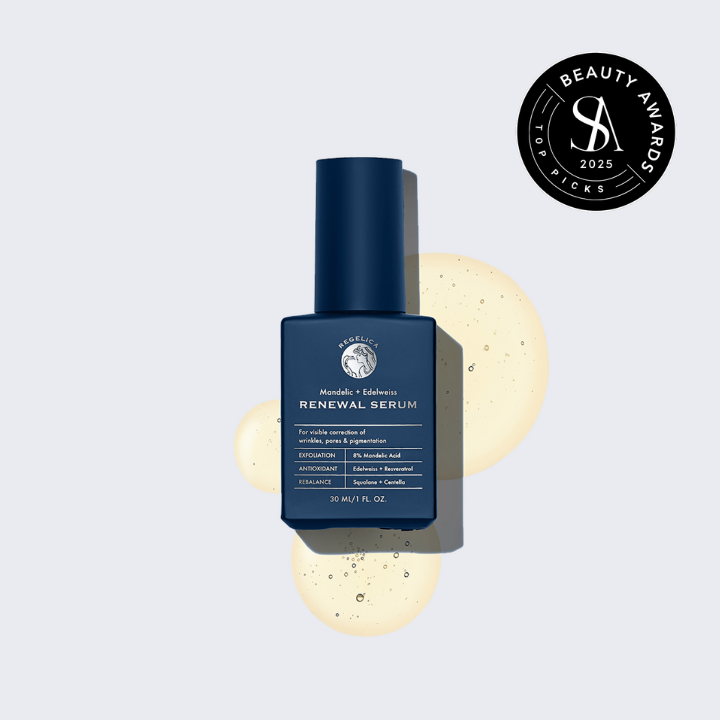
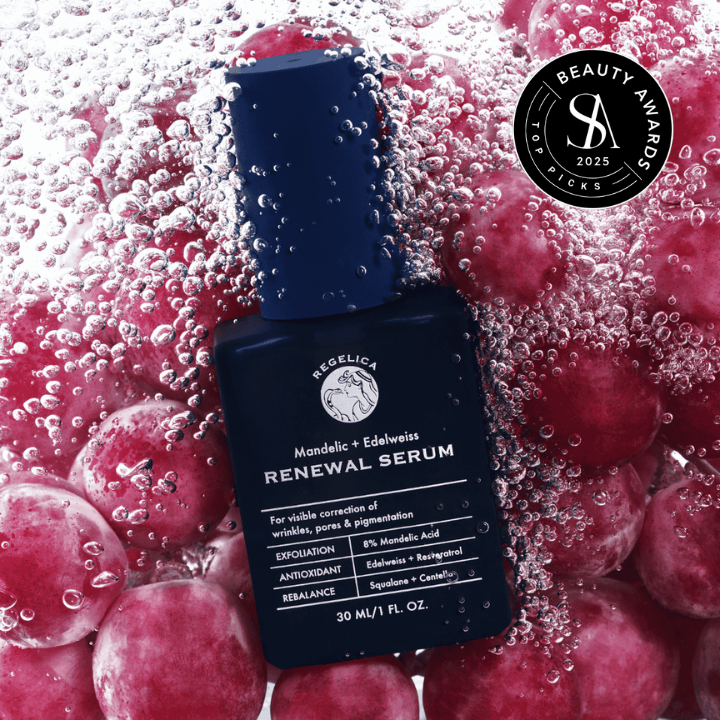
After roughly 30 rounds of trial formulations, we landed on our Renewal Serum: 8% mandelic acid, a mix of antioxidants (edelweiss extract, resveratrol), soothing panthenol, and plumping squalane.
Why Mandelic acid? It is an AHA, like glycolic acid, but with a larger molecule size — which means slower skin penetration and typically less irritation, making it a gentler option for people whose skin reacts to stronger acids. Paired with panthenol and squalane to offset any dryness. A mandelic acid serum that doesn't dry out your skin — check! Visible results after just one night — check! One solution that targets wrinkles, dark spots, and large pores — check!
Step 4: Moisturizer — What Asian Skin Collagen Density Taught Us About Aging

This product is actually what started the whole brand. Two ideas inspired it: the everyday phrase "thick-skinned" — skin that shrugs off aggressors — and research into Asian skin morphology, which has observed denser collagen structure in Asian skin compared to some other skin types, a difference researchers have linked to slower visible signs of aging. We wanted to formulate toward that kind of resilience, which meant addressing skin at more than one layer:
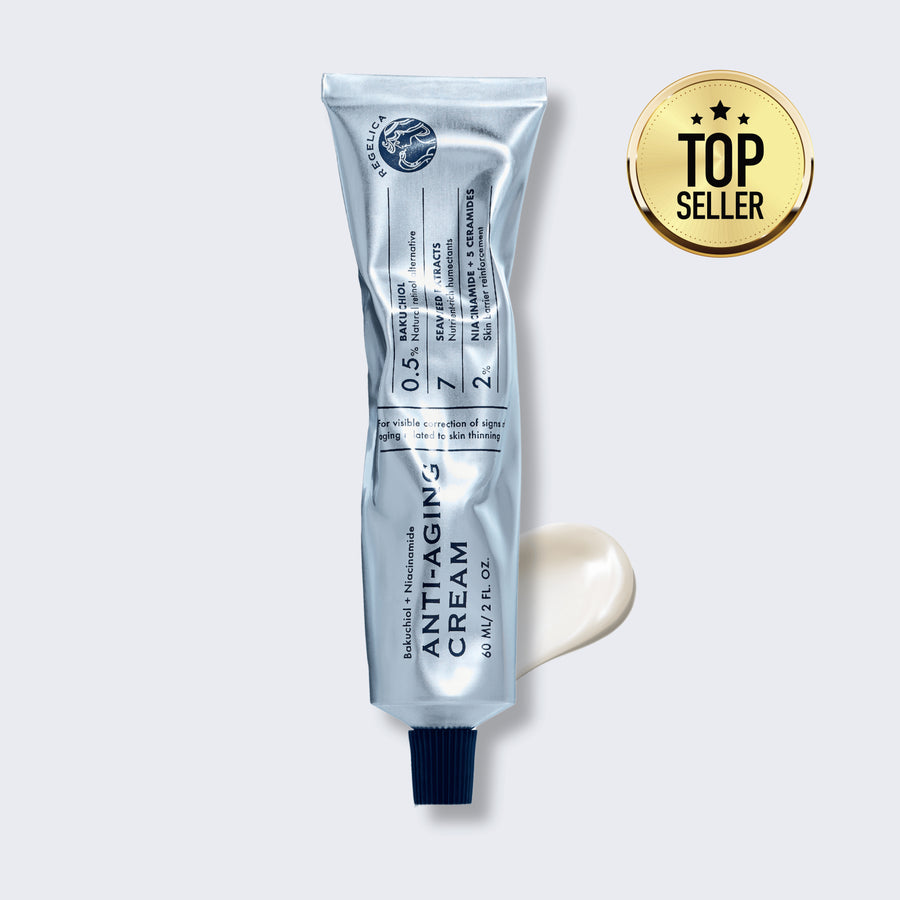
Barrier first. Your skin barrier is the outermost layer of your skin. It's often compared to a brick wall: skin cells are the "bricks," while ceramides, cholesterol, and free fatty acids form the lipid "mortar" that holds everything together. The barrier prevents water loss and blocks environmental aggressors. Our cream uses five ceramides (most Western formulas use three), plus cholesterol, fatty acids, and 2% niacinamide, which supports skin's own ceramide production.
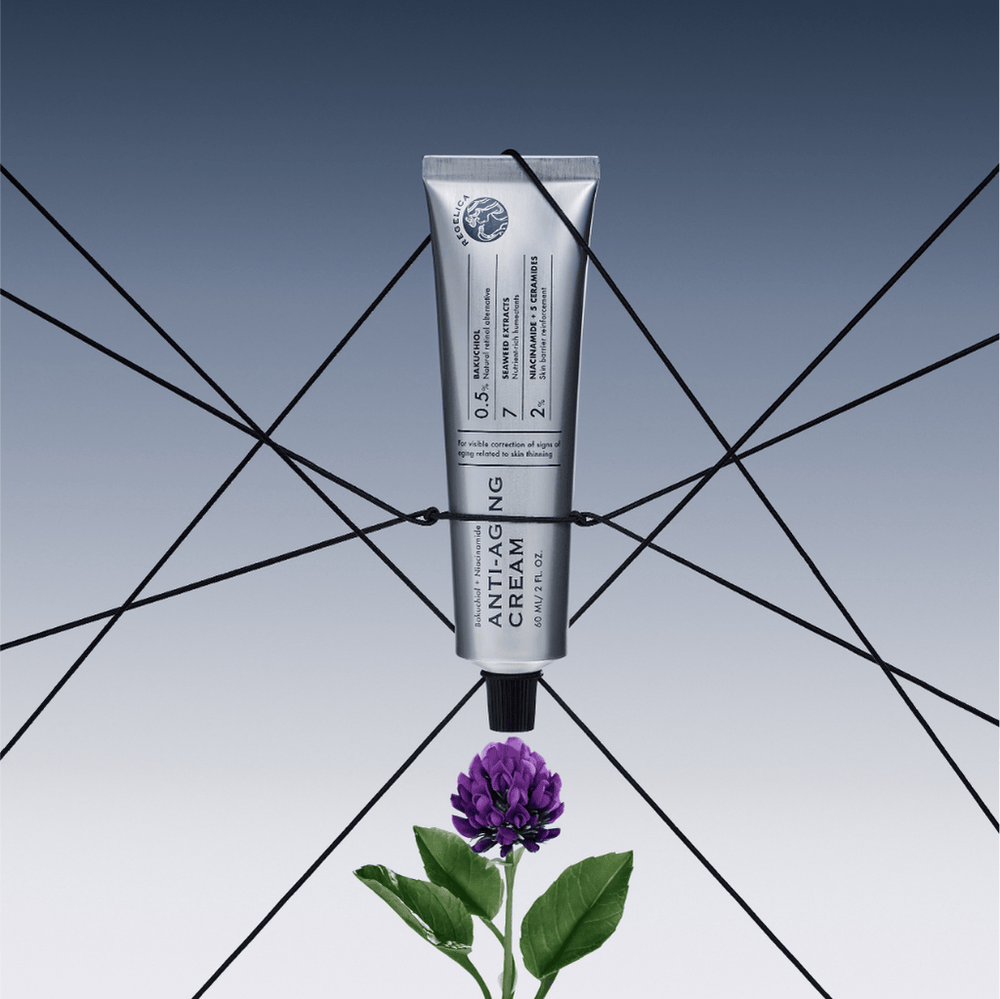
Then collagen support—but never forgetting the foundation. Many of the most commonly recommended collagen-stimulating ingredients, such as retinoids and pure vitamin C, can compromise the skin barrier, especially when overused or introduced too aggressively. We wanted an ingredient that supports collagen while respecting the barrier we've worked so hard to strengthen. That's why we chose 0.5% bakuchiol—a concentration studied for delivering benefits comparable to retinol in some research, but generally with a gentler tolerability profile. It was a meaningful choice for skin like ours that reacted poorly to stronger retinoids.
Finally, seaweed extract for hydration. Seven seaweed extracts, among nature's most nutrient-dense ingredients and powerful humectants — picture how much a piece of dried seaweed expands when it absorbs water; that's the same water-holding capacity working for your skin.
The result is a bakuchiol cream that supports the visible look of firmer, more contoured skin — the kind of result most influencers chase with retinoids — but with less irritation, while also delivering long-lasting hydration, soothing benefits, and a plumper-looking complexion.
The Bottom Line
We believe gentle is powerful. With a consistent four-step routine, you'll be surprised by how much your skin can improve over time. A systematic approach doesn't have to be a complicated one—just four thoughtful steps for skin that's more resilient, more radiant, and healthier from within.